

Understanding Calories: What They Are and Why They Matter?
Calories are the energy your body needs to function every day. Understanding how calories work can help you make informed food choices, maintain a healthy weight, and build sustainable eating habits without following restrictive diets.
📌 Key Takeaway
Calories are simply a way of measuring how much energy food provides. Every food and drink contains calories, and your body uses this energy to perform essential functions such as breathing, walking, exercising, and repairing tissues.
The number of calories you need each day depends on several factors including your age, gender, body weight, activity level, and health goals. Someone trying to lose weight generally aims to eat fewer calories than they burn, while someone trying to gain weight usually needs to consume more calories than they use.

Understanding calorie intake doesn’t mean avoiding your favourite foods. Instead, it helps you make informed choices, control portion sizes, and create a balanced diet that supports long-term health.
Whether you’re counting calories for weight loss, muscle gain, or simply maintaining a healthy lifestyle, learning how different foods contribute to your daily energy intake is an excellent place to start.
Calories are one of the most talked-about topics in nutrition, yet they’re often misunderstood. Many people associate calories only with weight gain or weight loss, but in reality, calories are simply a measure of energy. Every heartbeat, every breath you take, every step you walk, and even every thought your brain processes requires energy supplied by calories from the foods and drinks you consume.
Your body needs calories whether you’re sleeping, working, exercising, or relaxing. Without enough energy, your organs cannot function properly, your muscles become fatigued, and your overall health begins to suffer. On the other hand, regularly consuming more calories than your body uses can gradually lead to weight gain, while consistently eating fewer calories than you burn may result in weight loss.
Understanding calories isn’t about avoiding certain foods or obsessively counting every bite. Instead, it’s about learning how food provides energy and how different eating habits influence your overall health. Once you understand this basic concept, making healthier food choices becomes much easier.
In this guide, you’ll learn what calories are, where they come from, how many your body needs, and why the quality of those calories is just as important as the quantity. We’ll also explain common calorie myths, practical nutrition tips, and how calories fit into a balanced lifestyle.
Whether your goal is to lose weight, gain healthy weight, improve athletic performance, or simply understand nutrition better, this guide will provide the foundation you need.
What Is a Calorie?
A calorie is a unit of energy. In nutrition, calories measure the amount of energy that foods and drinks provide when your body digests and uses them. Every bite of food you eat contains energy that fuels your body’s essential functions.
Although people commonly say “calories,” food labels actually refer to kilocalories (kcal). One kilocalorie represents the amount of energy needed to raise the temperature of one kilogram of water by one degree Celsius. For simplicity, nutrition labels shorten the term to “Calories” with a capital “C.”
Think of calories as the fuel that powers your body, much like petrol powers a car. Without enough fuel, your body cannot perform everyday tasks efficiently. However, unlike a car, your body constantly uses energy—even when you’re resting.
Calories are essential for:
- ❤️ Keeping your heart beating
- 🫁 Supporting breathing and lung function
- 🧠 Powering your brain and nervous system
- 💪 Moving your muscles during daily activities
- 🌡️ Maintaining normal body temperature
- 🩹 Repairing tissues and supporting growth
- 🛡️ Helping your immune system function properly
Calories themselves are not good or bad. What matters is where those calories come from and whether they meet your body’s nutritional needs.
For example, 200 calories from fresh fruit, yoghurt, and nuts provide vitamins, minerals, fibre, and protein, while 200 calories from sugary soft drinks mainly provide energy with very little nutritional value. This is why nutrition experts encourage focusing on both calorie intake and food quality.
Why Does Your Body Need Calories?
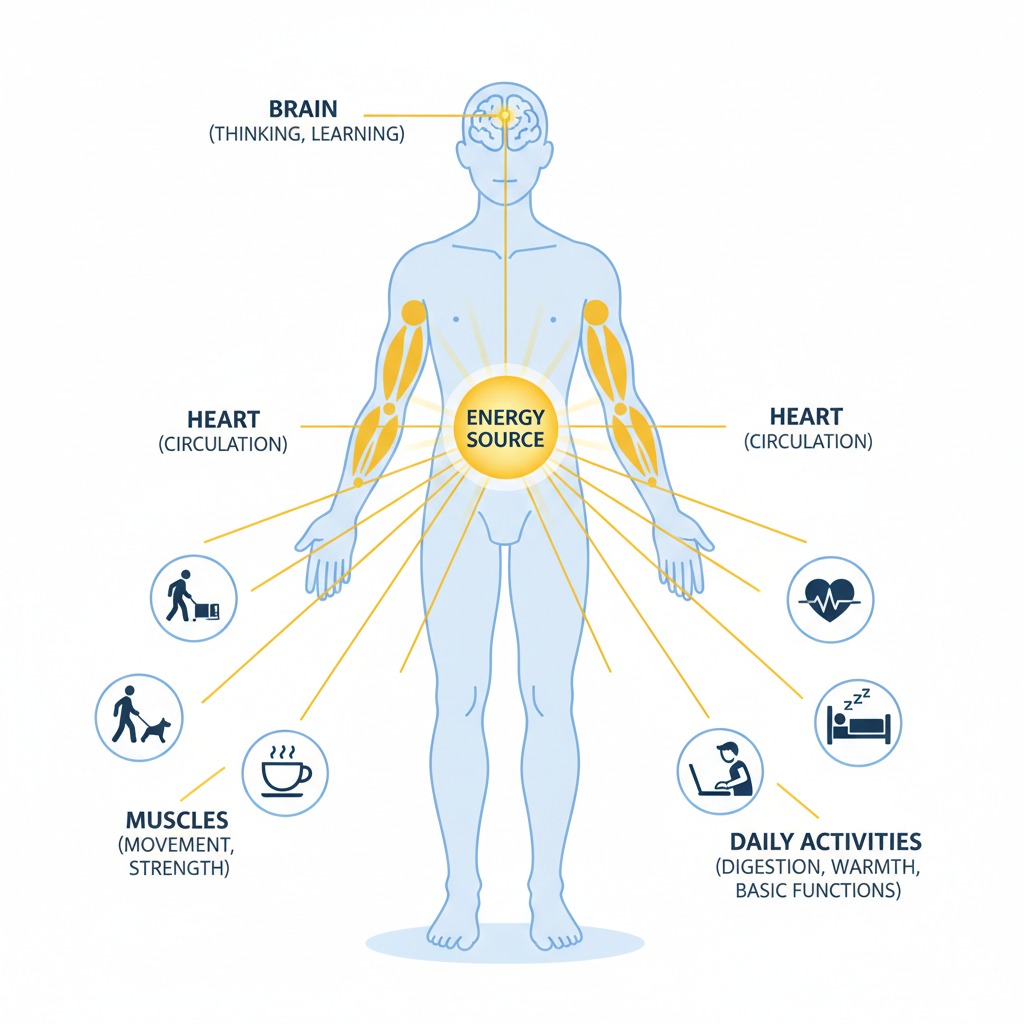
Many people believe calories are only important during exercise, but your body actually burns energy every minute of every day—even while you’re asleep.
The largest portion of your daily calorie use comes from your Basal Metabolic Rate (BMR), which is the energy your body requires to perform basic life-sustaining functions without any physical activity. These include breathing, circulating blood, maintaining body temperature, supporting brain function, and repairing cells.
Even if you spent an entire day resting in bed, your body would still burn a significant number of calories simply to keep you alive.
Your daily calorie expenditure generally comes from four main areas:
🧠 Basal Metabolic Rate (BMR)
This is the energy your body uses for essential functions such as breathing, heartbeat, circulation, digestion, and maintaining body temperature. For most adults, BMR accounts for the largest share of daily calorie needs.
🚶 Physical Activity
Walking, exercising, climbing stairs, working, and even household chores all require additional calories. The more active you are, the more energy your body needs.
🍽️ Digestion
Your body also burns calories while digesting, absorbing, and processing the food you eat. This is known as the Thermic Effect of Food (TEF).
🌱 Growth and Recovery
Children, teenagers, pregnant women, athletes, and people recovering from illness often require additional calories to support growth, muscle repair, and healing.
Because everyone’s body and lifestyle are different, there is no single calorie recommendation that works for everyone. Your ideal calorie intake depends on factors such as your age, sex, body size, activity level, and personal health goals.
🌟 Did You Know?
Your brain represents only about 2% of your body weight, yet it uses roughly 20% of your daily energy intake to support thinking, memory, concentration, and other essential functions.
✅ Internal Links
- Healthy Weight Gain
- Calories in White Rice
- Calories in Banana
- Calories in Milk
- Calories in Fried Eggs
- Calories in Peanut Butter
Continue reading:
👉 How Many Calories Do You Need to Gain Weight?